
Spirit of Freedom is proud to be accredited as an Advanced Ecotourism Operator. This is the highest eco certification attainable in Australia, and shows we provide a service that reflects our responsibility to contribute to the conservation of our Great Barrier Reef Marine Park and pass on this rich heritage to future generations. Our visitors have the opportunity to learn about the history and culture of the area, and appreciate our marine environment.
In 2024 our parent company, Entrada Travel Group, signed up to work towards becoming a carbonreduce certified organisation with Toitū Envirocare. Choosing Toitū Envirocare means partnering with a respected leader in sustainability certification. We’ve now measured our base year carbon footprint and are tracking and reporting on our emissions annually to ISO standards, to monitor changes from initiatives we implement. We’re moving into the future planning stage, identifying the focus areas to reduce our emissions consistently and mapping out a pathway to achieve a lower emissions future.


The health of the great barrier reef:
The reef is managed and cared for by GBRMPA, the Great Barrier Reef Marine Park Authority. They work alongside scientists, government departments, traditional owners, tourism operators and individuals to protect the reef from environmental threats and preserve it for future generations.
All tours to the reef incur an EMC or Environmental Management Charge which goes directly to GBRMPA to fund the day-to-day management of the park.
The Great Barrier Reef is primarily protected by the federal Environment Protection and Biodiversity Conservation Act 1999 and the Great Barrier Reef Marine Park Act 1975. 33% of the park is highly protected through a comprehensive multiple-use zoning plan.
Unfortunately, the Great Barrier Reef is facing several significant environmental challenges. Climate change is one of the most pressing threats. This refers to long-term shifts in global temperatures and weather patterns, largely due to greenhouse gas emissions driven by human activity, resulting in increased severe weather in certain places, melting of ice in polar regions increasing sea level, rising temperatures, ocean acidification and habitat changes. The reef is also facing significant pressures from pollution, overfishing, and coastal development. Read more about these potential threats here.
Despite these challenges, the reef is largely a thriving ecosystem, and there is hope to overcome the threats. Many scientists, citizen projects and the Great Barrier Reef Marine Park Authority work to ensure the preservation of the reef for future generations. Blueprint 2030 is a plan to build Climate resilience and adaptation for future changes and focusses on the entire reef ecosystem, highlighting the importance of biodiversity conservation.
Spirit of Freedom's Sustainability Actions
As an operator committed to reduce carbon emissions and environmental impacts, Spirit of Freedom have been recognised as a Climate Action Business under the Ecotourism Certification program. We are dedicated to protecting the natural environment that we all love and makes our experiences possible. We consider sustainability in day-to-day decisions across our operations, from taking climate action, to behaving with environmental and social responsibility, and contributing to conservation, which is recognised in our accreditation.
We’re taking these actions to reduce our emissions and improve our environmental impacts so future generations can experience this extraordinary World Heritage-listed ecosystem too:
- Measuring and tracking our carbon footprint via Toitū Carbon reduce
- Monitoring availability of alternative fuels and lower emissions technology
- Utilizing solar power at our administration office and workshop
- Renewing and servicing our vessels to maintain optimum fuel efficiency
- Minimising waste and recycling where possible
- Making responsible purchases through our sourcing decisions
- Equipping our vessels with two-stage wastewater treatment plants
- Managing water use through design features such as dual-flush toilets and low-flow showers
- Following best practice diving and snorkelling protocols and operating in line with all local legislation
- Participating in Great Barrier Reef monitoring programs such as Reef Health Impact Surveys, Eye on the Reef, BleachWatch (Coral Bleaching) and COTS Watch (Crown of Thorns Starfish)
- Supporting the Minke Whale Project by hosting researchers on board, encouraging donations from our guests and through t-shirt sales on board
- Encouraging our visitors to participate in tackling climate change, live sustainably and join conservation efforts in their own environment
What can visitors do to help protect the Reef?
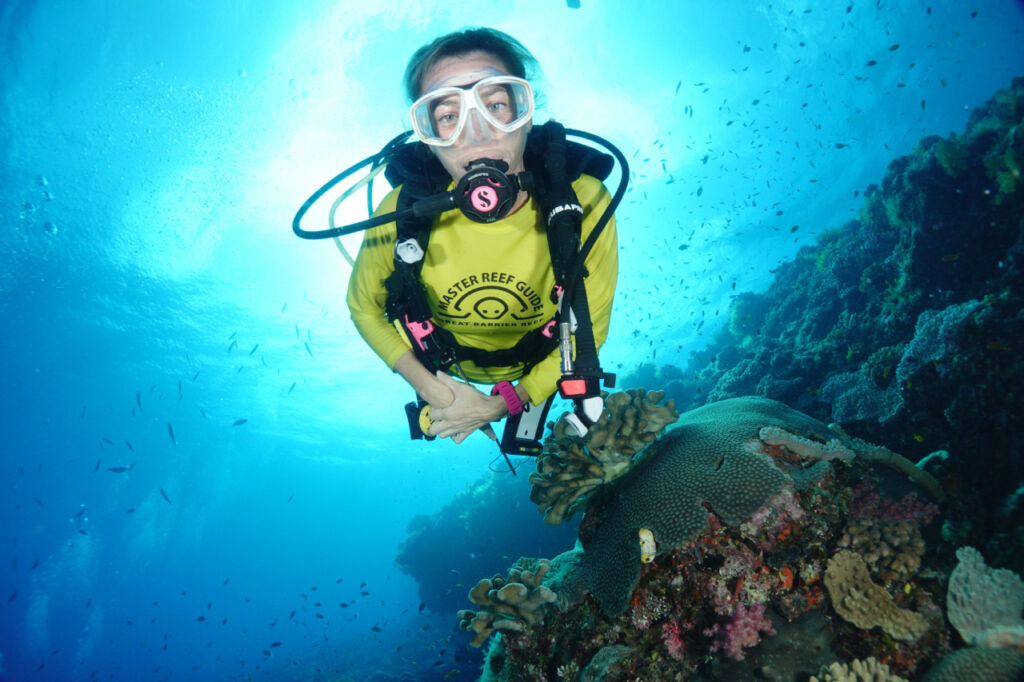
Diving and snorkelling is one of the best ways to take in the spectacular underwater views that the Great Barrier Reef has to offer, and to come face-to-face with captivating marine life. Although divers and snorkellers generally have had minimal impact upon the reef, there are times when some divers and snorkellers can stress the marine life or crush and break corals. By practicing good snorkel and dive practices, you’ll be able to preserve this special world for others to experience.
While you are diving or snorkelling, we encourage you to adopt the following practices:
- Move slowly and deliberately in the water, relax and take your time.
- Avoid rapid changes in direction.
- Avoid making sudden or loud noises underwater.
- Do not touch, lean on or hold onto any part of the reef.
- Avoid touching the walls of semi-confined areas (for example, small swim-throughs or overhangs) – never squeeze through a small area.
- Avoid kicking up and disturbing the sand, if you’re over a sandy area.
- Do not touch any animals or plants or relocate them in any way – particularly when taking photos and filming.
- Avoid feeding fish.
- Stay more than one metre away from giant clams.
- Keep clear of free-swimming animals (such as turtles, whales, and sea snakes). In particular, you must not chase, ride, grab or block the path of these animals.
- Do not wear gloves as you are more likely to touch the coral.
- Do not collect any shells, coral, or ‘souvenirs’, whether they are dead or alive.
- Collect all litter from the reef, even that which isn’t yours.
You can also help have a positive impact through your actions when joining a tour with us by following these tips.
Minimise your environmental impacts:
- Use public transport, walk or use a group pick up where available to reach your tour starting point
- Follow your guide’s instructions and signage for correct use of bins/recycling, water saving features, and wildlife interactions
- Make sure you don’t lose any rubbish or belongings into the environment
- Use reef-friendly sunscreen, insect repellent and toiletries
- Bring a water bottle to refill
- Be mindful of water use
- Return your brochure so we can keep it in circulation longer
Get involved with conservation:
- Join Citizens of the Great Barrier Reef
- Listen to guide talks and learn about the reef and threats
- Help with collection of monitoring data for marine debris surveys & eye on the reef when available
- Collect litter or debris
Show cultural sensitivity for respectful visits:
- Learn about local customs and protocols
To learn how to continue your sustainable actions read more on our page about sustainable travel and being more sustainable in your everyday life.
Acknowledgement of Country
Jiigurru (Lizard Island) is traditionally owned by the Dingaal people, whose ancestors have a long and valued history within the region. Spirit of Freedom acknowledges this deep connection of the Dingaal people to land and sea country and would like to acknowledge their elders past, present and emerging.